
RNA sequencing (RNA-seq) has become a standard tool for studying gene expression, helping researchers investigate everything from disease mechanisms and drug responses to biomarker discovery and cell biology. However, not all RNA-seq workflows generate the same type of data.
Two commonly used approaches are whole transcriptome sequencing (WTS) and 3′ RNA sequencing (3′ RNA-seq). Both enable transcriptome-wide gene expression analysis, but they differ significantly in the information they provide, the sequencing depth required, and their suitability for different experimental goals.
Choosing the right approach at the start of a project can help ensure that sequencing budgets are spent on generating the most useful data for the biological question being asked.

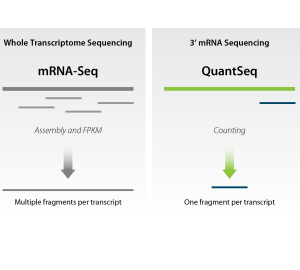
Figure 1. 3' mRNA sequencing methods generate reads from the 3' end of polyadenylated transcripts, primarily covering the 3' UTR and terminal exons. WT) uses random priming to generate reads across the full transcript length, including the 5' UTR, coding region, and 3' UTR.
What is whole transcriptome sequencing?
Whole transcriptome sequencing generates reads across the length of RNA transcripts, providing a comprehensive view of the transcriptome. Because sequencing reads are distributed throughout transcripts, WTS can be used not only to measure gene expression but also to investigate transcript structure.
Researchers can study:
- Gene expression levels
- Transcript isoforms
- Alternative splicing events
- Fusion transcripts
- Long non-coding RNAs
- Novel transcript discovery
This breadth of information makes whole transcriptome sequencing a powerful choice when understanding transcript architecture is important to the study.
The main drawback is that generating this additional information requires greater sequencing depth. As a result, WTS typically involves higher sequencing costs and more complex downstream data analysis than targeted gene-counting approaches.
What is 3′ RNA sequencing?
3′ RNA sequencing focuses on a short region at the 3′ end of polyadenylated transcripts rather than sequencing across the entire transcript. Each transcript is effectively represented by a single sequencing tag, creating a highly efficient method for counting RNA molecules and measuring gene expression. Instead of providing detailed information about transcript structure, 3′ RNA-seq is designed primarily for gene-level quantification.
This targeted approach offers several practical advantages:
- Lower sequencing requirements
- Reduced cost per sample
- Simpler bioinformatic analysis
- Higher sample throughput
- Good performance with partially degraded RNA
For studies that only need to determine whether genes are upregulated or downregulated between sample groups, 3′ RNA sequencing can often provide all the information required.
Whole transcriptome sequencing vs 3′ RNA sequencing
The biggest difference between these approaches is the level of biological detail they provide.
| Feature | Whole transcriptome sequencing | 3' RNA sequencing |
|---|---|---|
| Gene expression analysis | Yes | Yes |
| Differential expression studies | Yes | Yes |
| Transcript isoform detection | Yes | Limited |
| Alternative splicing analysis | Yes | Limited |
| Fusion transcript detection | Yes | Limited |
| Novel transcript detection | Yes | No |
| Sequencing depth required | Higher | Lower |
| Cost per sample | Higher | Lower |
| Large cohort studies | Possible | Well-suited |
For many differential expression experiments, both approaches can produce similar biological conclusions at the gene level. However, if transcript variants or splice events are biologically important, whole transcriptome sequencing provides information that 3′ RNA-seq cannot capture.
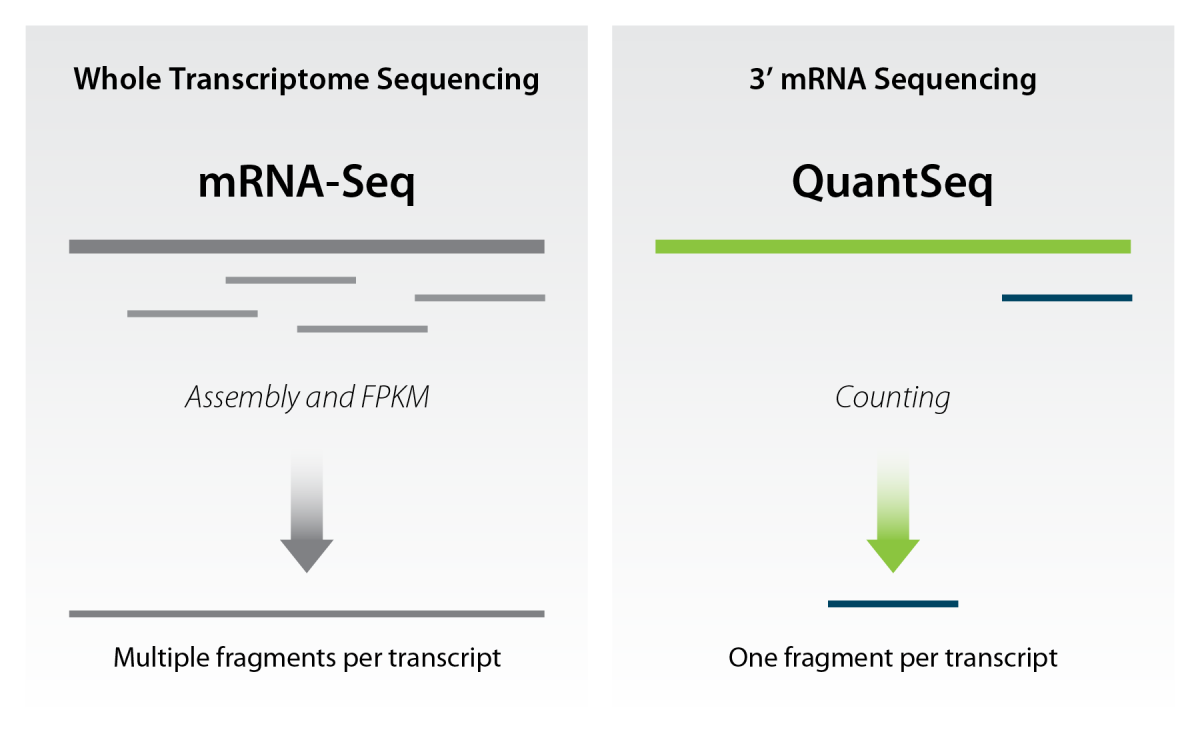
Figure 2. Whole transcriptome sequencing (WTS) generates reads across the full length of transcripts, providing information on transcript structure and sequence composition. In contrast, 3' mRNA sequencing methods focus read coverage at the 3' end of transcripts, enabling gene expression analysis through direct transcript counting. Each approach is designed to address different research objectives.
When should you choose whole transcriptome sequencing?
Whole transcriptome sequencing is generally the preferred option when researchers need the most complete view of transcriptomic activity.
Typical applications include:
- Alternative splicing studies
- Isoform expression analysis
- Fusion transcript detection
- Cancer transcriptomics research
- Rare disease investigations
- Novel transcript discovery projects
Although the sequencing costs are higher, the additional information can be valuable when a project's success depends on understanding transcript structure rather than simply measuring expression levels.
Whole transcriptome sequencing can also offer greater long-term value, as datasets may be re-analysed in the future to address new research questions beyond the original study objectives.
When should you choose 3′ RNA sequencing?
3′ RNA sequencing is often the better choice when gene expression quantification is the primary objective.
It is particularly well suited to:
- Drug response studies
- Biomarker discovery programmes
- Functional genomics experiments
- CRISPR screening projects
- Large patient cohorts
- High-throughput expression profiling
In these applications, researchers can often analyse more samples within the same budget than would be possible using whole transcriptome sequencing. This can be especially important because increasing the number of biological replicates often improves statistical power more effectively than increasing sequencing depth alone.
Another advantage is compatibility with lower-quality RNA samples, making 3′ RNA-seq a useful option for archived tissue samples and some clinical specimens.
Choosing the right approach
Neither method is inherently better than the other. The best choice depends on the biological question being asked. If your study requires information about transcript structure, alternative splicing, or isoform expression, whole transcriptome sequencing provides the most comprehensive dataset.
If your goal is to quantify gene expression across a large number of samples in a cost-effective way, 3′ RNA sequencing is often the more practical solution. Solutions such as QuantSeq from Lexogen offer cost-efficient analysis of differential gene expression via 3’ mRNA-seq library preparation. Lexogen's CORALL kits enable easy and cost-efficient generation of UMI labelled, stranded libraries for whole transcriptome analysis.
In simple terms, whole transcriptome sequencing is designed to reveal how transcripts are built, while 3′ RNA sequencing is designed to count how many transcripts are present. Understanding which of these questions matters most for your research will help determine the most appropriate sequencing strategy.
Contact our Lexogen specialists for guidance on which approach is best suited to your research.