
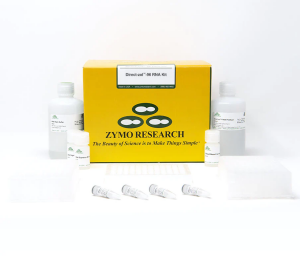
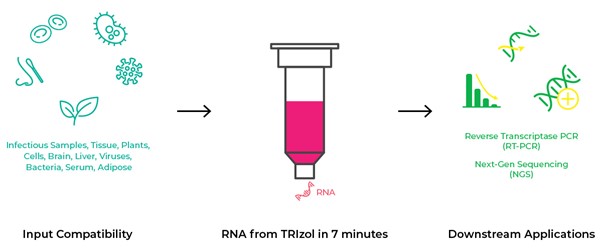
RNA purification is one of the most technically sensitive steps in experimental workflows. Speed is often viewed as a compromise on quality, with the perception that shorter protocols must sacrifice RNA integrity, reproducibility, or downstream performance. This is largely rooted in the traditional TRIzol® workflow, a method that demands time-consuming manual steps and careful phase handling to maintain RNA quality. Zymo Research’s Direct-zol™ technology challenges this assumption by demonstrating that a rapid workflow can improve both efficiency and data reliability, delivering high-quality RNA directly from TRIzol® in as little as 7 minutes.
Traditional TRIzol® workflows:
- Require phase separation and precipitation
- Involve multiple tube transfers
- Take 30-60 minutes
- Are highly operator‑dependent
Direct‑zol™ workflows:
- Bind RNA directly from TRIzol®
- Eliminate precipitation and pellet drying
- Take as little as 7 minutes
- Deliver consistent, high‑quality, sequencing‑compatible RNA
| Process step | Traditional TRIzol workflow | Direct-zol workflow |
|---|---|---|
| Sample lysis | Lyse sample in TRIzol® | Lyse sample in TRIzol® |
| Phase separation | Add chloroform, shake, incubate, centrifuge to form three layers (aqueous/organic/interphase) | Phase separation is not required |
| Aqueous phase recovery | Carefully aspirate the upper aqueous phase; avoid contamination from other layers | Not required as the entire TRIzol® mixture proceeds directly to binding |
| RNA precipitation | Add isopropanol, incubate, centrifuge to pellet RNA | Not required. RNA binds directly to the column |
| Pellet washing | Wash RNA pellet with 75% ethanol, centrifuge, remove wash | Wash column with provided buffers. No pellet handling |
| Pellet drying | Air‑dry pellet (risk of over‑drying or under‑drying) | Not required. No pellet formed |
| DNase treatment | Performed off-column; additional handling required | Performed directly on-column (optional, streamlined) |
| RNA elution | Resuspend RNA pellet in water or buffer | Elute RNA from the column into RNase‑free water or buffer |
| Hands-on time | ~30-60 minutes. Multiple manual, technique sensitive steps | As little as 7 minutes. Minimal handling, fewer steps |
| Workflow variability | High: multiple critical manual steps contribute variability | Low: simplified workflow with reduced operator dependence |
Direct‑zol™ accelerates discovery not by cutting corners, but by removing them, giving researchers speed, confidence, and superior workflow efficiency. Importantly, the removal of manual steps does not compromise RNA integrity. RNA extracted with Direct‑zol maintains high RIN values, exhibits excellent performance in qPCR and RTqPCR, and is fully compatible with RNA‑seq library preparation requirements. Direct-zol also ensures the unbiased recovery of smaller miRNAs than TRIzol® extraction. In many cases, the reproducibility of Direct‑zol™ exceeds that of traditional TRIzol extraction precisely because the workflow eliminates so many operator dependent variables.
Reduced complexity, increased quality and reproducibility
An advantage of Direct‑zol™ is not only speed but the reduction of steps that carry risk:
- Phase separation can be influenced by sample type, pipetting technique, or slight timing differences.
- Precipitation efficiency varies with temperature and alcohol ratios.
- Pellet washing and drying introduce further opportunities for inconsistency.
By bypassing these steps entirely, Direct‑zol™ reduces the accumulation of small technical variations that often influence downstream gene expression measurements.
This simplified workflow leads to more predictable extraction performance, particularly in high-throughput environments or when processing heterogeneous samples. Because fewer manual operations are required, inter-operator variation decreases, and labs gain confidence in the reproducibility and comparability of their data.
Accelerating discovery without sacrificing scientific standards
RNA extraction is a foundational step in many molecular workflows. Faster and more reproducible purification has direct benefits for research timelines; pilot studies progress more rapidly, iterative experiment cycles shorten, and data becomes available sooner for interpretation and decision making. These gains compound in multiday or multisample studies, where workflow efficiency can meaningfully influence project momentum.
Crucially, Direct‑zol™ achieves these time savings while maintaining or improving RNA quality and consistency. Faster decisions arise not because researchers are cutting corners, but because the workflow itself has removed the unnecessary ones.
Conclusion
The idea that speed and quality are mutually exclusive in RNA purification is rooted in outdated protocol constraints, rather than fundamental scientific limitations. Direct‑zol™ demonstrates that by eliminating the most error-prone steps of the traditional TRIzol® workflow, researchers can obtain high quality‑ RNA in a fraction of the time, with greater reproducibility and confidence. Faster methods do not inherently compromise results; when thoughtfully designed, they can strengthen them.
Do you have a workflow Direct-zol could help with? Request a free sample and experience the speed and efficiency for yourself!