

Next-generation sequencing (NGS) has transformed genomics, making it possible to generate large volumes of sequencing data quickly and cost-effectively. While sequencing technologies continue to evolve, researchers today generally choose between two broad approaches: short-read sequencing and long-read sequencing.
Both methods can deliver valuable insights, but they are designed to address different research challenges. Understanding their strengths, limitations, and typical applications can help researchers select the most suitable approach for their projects.
What is short-read sequencing?
Short-read sequencing generates millions to billions of relatively short DNA fragments, typically between 50 and 300 base pairs in length. Technologies such as Sequencing by Synthesis (SBS) from Illumina have become widely adopted due to their high accuracy, high throughput, and cost efficiency. After sequencing, bioinformatics tools align these short fragments to a reference genome or assemble them computationally to reconstruct the original sequence.
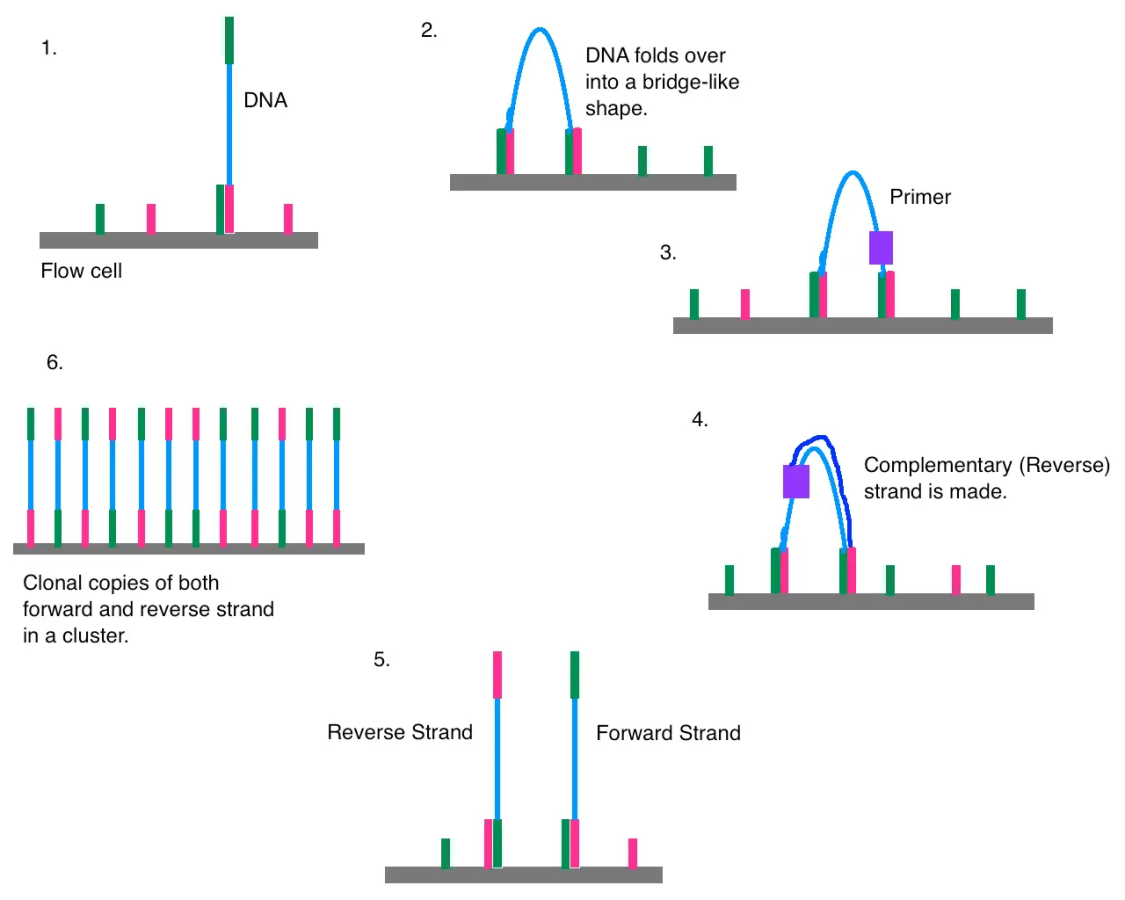
Figure 1. This illustration demonstrates the five-step process behind Illumina sequencing-by-synthesis technology. Adapter-ligated DNA fragments are captured within the flow cell, where they form single-stranded templates for sequencing. A primer binds to each template strand, and DNA polymerase sequentially incorporates labelled nucleotides. Imaging after each incorporation event records the added base, generating the nucleotide sequence one base at a time.
Advantages of short-read sequencing
Short-read sequencing is often the preferred choice when researchers require:
- High sequencing accuracy
- Large-scale sample processing
- Well-established workflows and analysis pipelines
- Cost-effective whole genome, exome, or targeted sequencing
- Reliable detection of single nucleotide variants (SNVs) and small insertions or deletions
These strengths have made short-read sequencing a standard tool across research areas including human genetics, oncology, infectious disease research, and population genomics.
Limitations of short-read sequencing
Although highly effective for many applications, short reads can struggle when analysing complex genomic regions. Challenges may include:
- Resolving repetitive DNA sequences
- Characterising large structural variants
- Phasing variants across long genomic distances
- Assembling highly complex genomes
- Analysing regions with significant rearrangements
In these situations, the limited length of individual sequencing reads can make accurate genome reconstruction more difficult.
What is long-read sequencing?
Long-read sequencing technologies generate substantially longer sequence reads, often ranging from several kilobases to more than 100 kilobases in a single read. Platforms from providers such as Oxford Nanopore Technologies and Pacific Biosciences (PacBio) enable researchers to analyse extended stretches of DNA or RNA without breaking them into numerous short fragments. Because longer reads preserve more genomic context, they can simplify the analysis of complex regions that are difficult to resolve using short-read approaches.
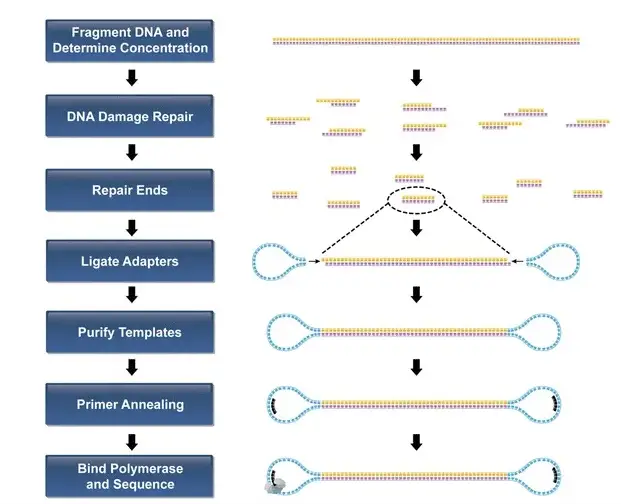
Figure 2. In PacBio Single Molecule, Real-Time (SMRT) sequencing, DNA templates are converted into circular SMRTbell libraries and loaded into ZMWs containing immobilised DNA polymerase. Fluorescent signals emitted during nucleotide incorporation are recorded in real time, and repeated passes around the circular template are combined to produce highly accurate HiFi reads.
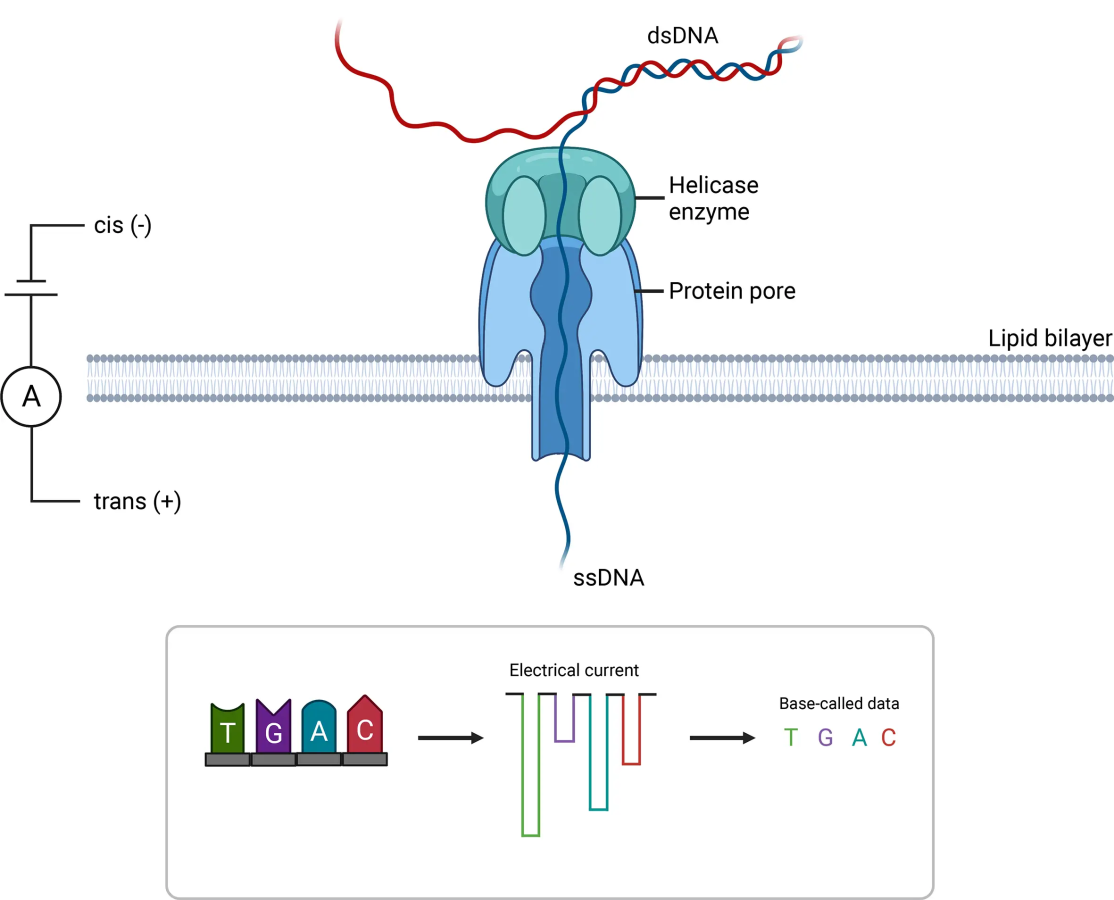
Figure 3. In Oxford Nanopore sequencing, a motor protein guides a DNA molecule through a nanopore while an electrical current is applied across the membrane. Characteristic disruptions in the current are detected and translated into nucleotide sequence information, enabling real-time sequencing of long DNA or RNA molecules.
Advantages of long-read sequencing
Long-read sequencing offers several important benefits:
- Improved genome assembly
- Better resolution of repetitive regions
- Detection of large structural variants
- More accurate haplotype phasing
- Full-length transcript sequencing
- Direct analysis of epigenetic modifications with certain platforms
These capabilities have expanded the use of long-read sequencing in areas such as rare disease research, plant genomics, microbial genomics, transcriptomics, and de novo genome assembly.
Limitations of long-read sequencing
Researchers should also consider potential trade-offs. Compared with short-read sequencing, long-read approaches may involve:
- Higher per-sample sequencing costs
- Lower throughput for some applications
- Greater input DNA quality requirements
- More specialised library preparation workflows
While long-read accuracy has improved significantly in recent years, project requirements should still be carefully evaluated when choosing a sequencing strategy.
Short-read vs long-read sequencing: a comparison
| Feature | Short-read sequencing | Long-read sequencing |
|---|---|---|
| Typical read length | 50-300bp | Several kb to >100 kb |
| Accuracy | Very high per-base accuracy | High and continually improving |
| Throughput | Very high | Moderate to high |
| Cost per base | Lower | Higher |
| Structural variant detection | Limited | Strong |
| Genome assembly | More challengin for complex genomes | Often simpler and more complete |
| Repetitive region analysis | Difficult | Improved resolution |
| Variant phasing | Limited | Strong |
| Established workflows | Extensive | Growing rapidly |
When should you choose short-read sequencing?
Short-read sequencing is often well suited when researchers need:
- Population-scale sequencing studies
- Variant discovery in well-characterised genomes
- Cost-effective high-throughput sequencing
- Clinical research workflows using established analytical pipelines
- Large cohort projects requiring consistent, scalable data generation
For many routine genomic applications, short-read platforms continue to provide an effective balance of performance, accuracy, and cost.
When should you choose long-read sequencing?
Long-read sequencing may be the preferred option when projects involve:
- De novo genome assembly
- Complex structural variant analysis
- Repeat-rich genomic regions
- Full-length transcript sequencing
- Haplotype phasing studies
- Characterisation of previously unresolved genomic regions
In these cases, the additional genomic context provided by longer reads can help answer questions that are difficult to address using short-read data alone.
Increasingly, researchers use both. Rather than viewing short-read and long-read sequencing as competing technologies, many researchers now combine both approaches within a single workflow. Hybrid sequencing strategies can leverage:
- The high accuracy and throughput of short reads
- The structural resolution provided by long reads
- More complete genome assemblies
- Enhanced variant detection
- Improved confidence in complex genomic analyses
This complementary approach is becoming increasingly common in genomics projects where data completeness and accuracy are both priorities.
Choosing the right sequencing strategy
The best sequencing approach depends on the biological question being investigated. When selecting a workflow, researchers should consider:
- The complexity of the genome or transcriptome being analysed
- The types of variants being studied
- Required sequencing depth and throughput
- Budget considerations
- Available bioinformatics expertise
- Sample quality and quantity
A clear understanding of project objectives can help determine whether short-read sequencing, long-read sequencing, or a hybrid strategy is most appropriate.
As sequencing technologies continue to advance, researchers have access to an increasingly diverse set of tools for exploring genomic variation, gene expression, and genome structure. Choosing the right approach starts with understanding the strengths of each technology and aligning them with the needs of the study.
Supporting NGS workflows from sample to discovery
Generating high-quality sequencing data depends on every stage of the workflow, from sample preparation and library construction through to sequencing and analysis. Cambridge Bioscience works with trusted technology partners to provide researchers with solutions that support NGS workflows across a wide range of applications.
Our team can help identify the most suitable products and technologies for your sequencing objectives, whether you are conducting routine short-read sequencing, advanced long-read analysis, or integrated multi-omics research.
This blog was inspired by Zymo Research's original content.