
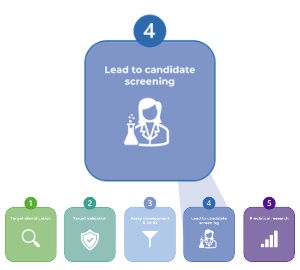
Once an assay has been developed, drug discovery moves from establishing how compounds will be tested, to determining which compounds are worth progressing.
This is a process of continual selection. Initial screening may identify numerous compounds with activity against a target, but activity alone is not enough to make a viable drug. Researchers must progressively confirm those results, understand how compounds behave and optimise promising chemical series before selecting molecules for further development (1).
This journey can be considered across three connected stages: hit identification, lead optimisation and lead-to-candidate screening.
Hit identification: finding the starting points
Hit identification aims to find compounds that produce the desired activity in a validated screening assay. Depending on the programme, potential hits can be discovered using approaches such as high-throughput screening (HTS), fragment-based drug discovery or virtual screening (1).
In HTS, large compound libraries can be tested against an established biochemical or cell-based assay. The primary screen is intended to efficiently identify potentially active compounds, rather than fully characterise them.
Potential hits need to be confirmed through additional experiments. Compounds may be retested using concentration-response assays to establish whether activity is reproducible and concentration dependent. Orthogonal assays, which investigate the same biological activity using an alternative detection technology or assay format, can help identify assay interference and other false-positive results (2).
Counter-screening can also be introduced to distinguish activity against the intended target or pathway from non-specific effects.
Together, these experiments gradually narrow the initial collection of screening hits to a smaller number of confirmed compounds and chemical series suitable for further investigation.
From hit to lead
Following confirmation, promising hits undergo further characterisation to determine whether they provide suitable starting points for medicinal chemistry (1).
At this stage, researchers begin looking beyond basic activity. Important questions include:
- How potent is the compound?
- Is it selective for the intended target?
- Does activity translate from biochemical to cellular assays?
- Does the compound have suitable physicochemical properties?
- Are there early indications of toxicity or undesirable off-target effects?
Initial absorption, distribution, metabolism and excretion (ADME) testing can also begin to identify potential issues that may inhibit progression (3).
Instead of selecting compounds purely because they have the lowest IC50 or EC50 values, researchers can use this wider evidence to identify lead series with a balance of desirable characteristics.
Lead optimisation: improving compound properties
Once promising leads have been identified, lead optimisation aims to progressively improve their properties. This generally involves repeated design-make-test-analyse cycles. Medicinal chemists modify molecular structures and the resulting compounds are tested using a range of biological and physicochemical assays. The results then inform the next round of structural design (3).
Potency remains important, but assay panels can also investigate selectivity, cellular activity and mechanism of action. At the same time, ADME studies may examine properties such as solubility, permeability, metabolic stability, protein binding and cytochrome P450 interactions (3).
The challenge is that improvement in one property can come at the expense of another. Modifying a compound to increase potency, for example, may adversely affect solubility or metabolic stability (1, 3).
Screening data allow these properties to be assessed alongside one another, helping medicinal chemists understand structure-activity relationships and determine which modifications produce the strongest overall compound profile.
Bringing greater biological relevance into screening
As compounds progress, screening assays can also become more biologically relevant. An early biochemical assay provides a controlled method for investigating activity against a defined target, but it cannot fully represent the complexity of a cellular environment. Cell-based assays can therefore help establish whether activity translates into the desired biological response (1).
Depending on the target and therapeutic area, increasingly complex cellular models can help researchers explore compound behaviour under conditions that more closely reflect relevant biology.
Using complementary assay formats is valuable throughout this process. Rather than depending on a single readout, researchers can build multiple layers of evidence around target activity, cellular effects and compound behaviour.
Lead-to-candidate screening: choosing what moves forward
Eventually, lead optimisation produces a smaller number of highly characterised compounds. Lead-to-candidate screening then focuses on generating the breadth of evidence needed to determine which molecule, or molecules, should progress towards preclinical development (1).
At this stage, compounds may be compared across multiple parameters, including:
- Potency and efficacy
- Target selectivity and off-target activity
- Cellular activity
- Physicochemical properties
- Metabolic stability
- Pharmacokinetic behaviour
- Early safety and toxicity indicators
Pharmacokinetic studies provide information about parameters such as exposure, clearance, half-life and bioavailability, while safety-focused assays can identify potential liabilities that would make continued development undesirable (4).
Safety assessment is another important consideration. Identifying potential toxicity and off-target liabilities earlier in discovery can inform compound design and help prevent unsuitable molecules from progressing into later stages of development (5).
Lead selection must also consider developability, manufacturability and intellectual property. Factors such as synthetic complexity, yield, raw-material availability, formulation, purification and production costs can determine whether a molecule can be manufactured consistently at scale. Leads with similar biological profiles may therefore differ significantly in development potential from a manufacturing point of view (6).
The development candidate is therefore not necessarily the most potent compound. A molecule with exceptional target potency but poor metabolic stability, low exposure, significant off-target activity, poor scalability or high production cost may ultimately be less attractive than a slightly less potent compound with a more balanced overall profile. Candidate selection is a multiparameter decision.
Screening as a progressive process
From the first screening hit to the selection of a development candidate, early drug discovery involves progressively increasing both the depth and biological relevance of the evidence surrounding each compound.
At hit identification, screening prioritises speed and the reliable detection of activity. As compounds move through lead optimisation, researchers introduce increasingly detailed measurements of potency, selectivity, cellular activity and suitability for further development.
A well-designed screening strategy supports this progression by ensuring assays remain appropriate for the decisions being made at each stage. Rather than being a single step in the drug discovery workflow, screening provides a continuous evidence base for narrowing the field from many initial hits to the small number of compounds with the strongest potential for further development.
Supporting your drug discovery workflow
From hit identification through lead optimisation and candidate selection, reliable tools and technologies are essential for generating the data needed to make confident decisions. Cambridge Bioscience offers a range of drug discovery workflow solutions supporting compound screening, assay development and optimisation, target engagement, cell-based studies and downstream analysis, helping researchers move promising compounds through each stage of early drug discovery.
References
1. Hughes JP, Rees S, Kalindjian SB, Philpott KL. Principles of early drug discovery. British Journal of Pharmacology. 2011;162(6):1239–1249. doi:10.1111/j.1476-5381.2010.01127.x.
2. Mahapatra D, Franzosa JA, Roell K, et al. Confirmation of high-throughput screening data and novel mechanistic insights into VDR-xenobiotic interactions by orthogonal assays. Scientific Reports. 2018;8:8883. doi:10.1038/s41598-018-27055-3.
3. Cheng KC, Korfmacher WA, White RE, Njoroge FG. Lead optimization in discovery drug metabolism and pharmacokinetics/case study: the hepatitis C virus (HCV) protease inhibitor SCH 503034. Drug Target Insights. 2007;2:103–117. doi:10.1177/1177391X0700100001.
4. Lai Y, Chu X, Di L, et al. Recent advances in the translation of drug metabolism and pharmacokinetics science for drug discovery and development. Acta Pharmaceutica Sinica B. 2022;12(6):2751–2777. doi:10.1016/j.apsb.2022.03.009.
5. Pognan F, Beilmann M, Boonen HCM, et al. The evolving role of investigative toxicology in the pharmaceutical industry. Nature Reviews Drug Discovery. 2023;22:317–335. doi:10.1038/s41573-022-00633-x.
6. International Council for Harmonisation. ICH Q11: Development and Manufacture of Drug Substances (Chemical Entities and Biotechnological/Biological Entities). 2012