The success of every therapeutic programme depends on asking the right biological question at the outset. Before a drug can be designed, screened or optimised, researchers must first understand what is driving disease and identify the most promising point of intervention.
At a glance
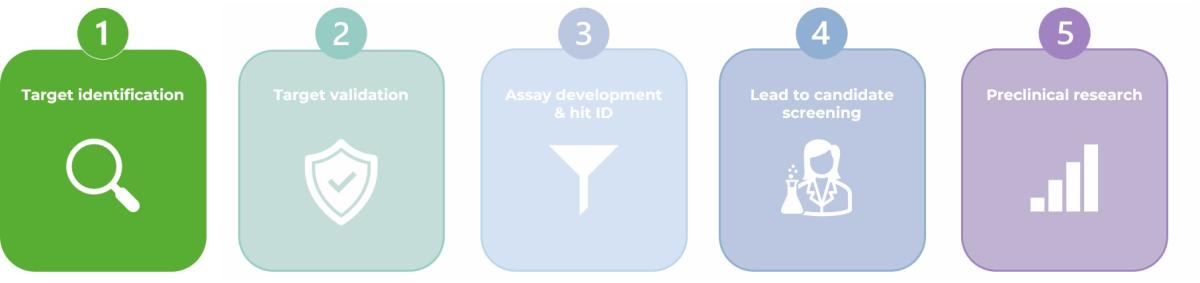
Disease understanding and target identification is the first formal stage of the drug discovery workflow. Its purpose is to uncover the biological mechanisms responsible for disease and identify a target whose modulation could produce therapeutic benefit.
A target may be a protein, receptor, enzyme, signalling pathway, RNA molecule, gene, cell population or biological process that plays a causal role in disease progression. Researchers combine data from genomics, transcriptomics, proteomics, epigenetics, pathology, immunology and increasingly artificial intelligence (AI) to determine which biological mechanisms are most likely to lead to effective therapies.
This stage forms the foundation for all downstream drug discovery activities.
When target selection is supported by robust biological evidence, particularly human genetic evidence, programmes are substantially more likely to succeed in later development stages. Conversely, poor target selection remains one of the leading causes of attrition throughout the pharmaceutical industry.1,2
Why disease understanding matters
The pharmaceutical industry has become highly efficient at generating potential therapeutic molecules. However, developing a successful medicine still begins with understanding disease biology. Historically, many drug discovery programmes failed not because the drug itself was poorly designed, but because the underlying target was not sufficiently linked to disease progression.1,2
This has driven a major shift in modern drug discovery. Rather than focusing primarily on finding molecules that interact with proteins, researchers now invest heavily in understanding disease mechanisms before a target enters validation. The objective is not simply to identify molecules associated with disease, but to determine which biological changes are genuinely causal and therefore represent meaningful opportunities for intervention.3,4
As our understanding of complex diseases has evolved, it has become clear that conditions such as cancer, autoimmune disease, neurodegeneration and metabolic disorders rarely result from single molecular abnormalities. Instead, they arise from interconnected biological networks involving genetic, environmental and cellular factors. Consequently, the target identification process increasingly focuses on understanding biological systems rather than isolated genes or proteins.
From disease biology to therapeutic targets
Target identification is the process of translating biological observations into therapeutic hypotheses that can then be acted upon and tested. Researchers typically begin by comparing healthy and diseased tissues, examining differences in gene expression, protein abundance, cellular composition and pathway activity. Modern discovery programmes often integrate data from patient-derived samples, clinical datasets, disease models and large-scale public databases.
The ideal therapeutic target should satisfy several criteria. It should have a clear role in disease progression, demonstrate evidence of causality, be amenable to pharmacological or biological modulation, and possess a favourable means to create balance between efficacy and safety. While these principles sound straightforward, identifying targets that meet all of these requirements remains a significant challenge.
Indeed, the emergence of systems biology has highlighted that many disease-associated molecules are merely downstream consequences of pathology rather than true disease drivers. Distinguishing between association and causation is therefore one of the most important objectives of early discovery research.
Human genetics has transformed target discovery
One of the most important developments in modern drug discovery has been the growing influence of human genetics. Large-scale sequencing projects, biobanks and genome-wide association studies (GWAS) have generated unprecedented insight into the genetic basis of disease. Numerous studies have demonstrated that drug targets supported by human genetic evidence are more likely to succeed in clinical development than those lacking such support.3-7
However, genetics rarely provides a complete picture on its own. Many disease-associated variants occur in regulatory regions rather than protein-coding genes. To understand how these variants influence disease, researchers must integrate genetics with additional biological information, including transcriptomics, protein expression and epigenetic regulation.5
As a result, drug discovery is increasingly moving towards multi-dimensional target assessment strategies that combine genetic, molecular and functional evidence to prioritise therapeutic targets with the greatest likelihood of success.
Transcriptomics and multi-omics approaches
The emergence of transcriptomics has fundamentally transformed disease understanding and identification of druggable targets. RNA sequencing allows researchers to investigate how gene expression changes across disease states and identify molecular pathways that may contribute to pathology. More recently, single-cell RNA sequencing and spatial transcriptomics have enabled scientists to explore biological systems at unprecedented resolution, revealing previously hidden cellular populations and tissue-specific disease mechanisms.4,7
These advances have significantly expanded the ability of researchers to identify novel targets and biomarkers. Rather than examining average gene expression across an entire tissue, scientists can now pinpoint disease-driving cell populations and investigate the biological interactions occurring within complex tissue environments.
This is an area where technologies from suppliers such as Lexogen provide particular value. Transcriptomics solutions support gene expression profiling, RNA sequencing workflows and biomarker discovery studies, helping researchers generate the high-quality molecular data required for target prioritisation.
Increasingly, transcriptomic information is integrated with genomic, proteomic and metabolomic datasets through multi-omics approaches. By combining multiple biological layers, researchers can gain a more complete understanding of disease mechanisms and identify targets that may not be apparent from any individual dataset alone.
Understanding regulation through epigenetics
Many diseases arise not from alterations in DNA sequence itself but from changes in gene regulation.Epigenetic mechanisms control when genes are activated, silenced or expressed at different levels. Dysregulation of chromatin structure, transcription factor activity and DNA methylation has been implicated in numerous diseases, including cancer, neurological disorders and chronic inflammatory conditions.8,9
Epigenetic research has therefore become an increasingly important component of disease understanding. Technologies that enable researchers to investigate chromatin dynamics, regulatory networks and transcriptional control mechanisms provide valuable insight into disease biology and can uncover entirely new classes of therapeutic targets.
Suppliers such as Active Motif support these investigations through tools for chromatin analysis, transcription factor research and epigenetic profiling, helping researchers move beyond simple gene expression measurements towards a deeper understanding of disease-driving regulatory networks.
Biomarkers and immunology in disease understanding
The immune system plays an increasingly recognised role in numerous diseases beyond traditional immunology. Chronic inflammation contributes to oncology, cardiovascular disease, neurodegeneration and metabolic disorders, while dysregulated immune responses drive autoimmune and inflammatory diseases. Understanding these immune mechanisms is therefore essential for modern target discovery. Researchers must frequently characterise inflammatory pathways, immune cell responses and biomarker signatures before selecting therapeutic targets. Biomarkers often provide critical evidence linking molecular mechanisms to disease progression and can help prioritise targets for further investigation.
This is an area where Hycult Biotech offers particular value. Its portfolio includes tools for studying cytokines, complement biology, innate immunity and inflammatory pathways. Complement biology has emerged as an especially important therapeutic area, with complement-targeted therapies now demonstrating clinical success across multiple disease indications. Measuring complement activation products, inflammatory mediators and immune biomarkers can therefore provide important insight during both disease understanding and target selection.10,11
Similarly, high-quality antibodies from suppliers such as Atlas Antibodies and Bethyl Laboratories support the investigation of target expression, protein localisation and pathway activity, helping researchers translate omics data into biological understanding.
Building the molecular tools for functional investigation
As targets emerge from discovery efforts, researchers must begin testing their biological function experimentally. Modern target discovery increasingly relies on genetic perturbation approaches, including CRISPR screening, gene overexpression studies and functional genomics workflows. These experiments require robust cloning systems, vector construction and DNA amplification before functional studies can begin.
This is where Lucigen's competent cell technologies make an important contribution. High-efficiency competent cells support the construction and propagation of plasmids, expression vectors, lentiviral constructs and CRISPR libraries that are used throughout target discovery and functional genomics research.
As programmes move closer to target validation, technologies from BPS Bioscience become increasingly relevant. Reporter cell lines, engineered cellular models and pathway-specific assay systems allow researchers to investigate biological function and begin establishing causal links between targets and disease-related phenotypes.
Key challenges in target identification
Despite significant advances in technology, target identification remains one of the most challenging stages of drug discovery. One major challenge is biological complexity. Human diseases involve diverse cell populations, dynamic biological networks and substantial patient-to-patient variability. Researchers must distinguish causal drivers from downstream consequences while integrating vast quantities of molecular and clinical data.2,4
Another challenge is data interpretation. High-throughput technologies routinely generate thousands of potential associations, yet only a small proportion ultimately represent viable therapeutic opportunities. Sophisticated bioinformatics tools and computational methods are therefore required to identify meaningful biological signals from increasingly large datasets.
Artificial intelligence is emerging as a powerful solution to these challenges. By analysing multi-omics data, biological networks and scientific literature at scale, AI-based approaches are helping researchers uncover novel targets and prioritise those most likely to produce clinical benefit. Although experimental validation remains indispensable, AI is rapidly becoming an important component of the target discovery toolkit.12
Looking ahead
Disease understanding and target identification have evolved into highly integrated scientific disciplines that combine genetics, transcriptomics, proteomics, epigenetics, immunology, systems biology and computational science.
The continued convergence of these fields is transforming the way researchers identify therapeutic opportunities. Multi-omics technologies, large-scale human datasets and AI-driven analytical approaches are allowing scientists to interrogate disease with unprecedented depth, increasing confidence in target selection and helping reduce downstream attrition.
Success increasingly depends on combining high-quality biological data with robust research tools. From transcriptomics solutions provided by Lexogen, to the epigenetics expertise of Active Motif, the immunology-focused assays of Hycult, the cloning technologies of Lucigen, and the functional cellular models developed by BPS Bioscience, researchers have access to an expanding toolkit for understanding disease and identifying the next generation of therapeutic targets.
Ultimately, every successful medicine begins with a deep understanding of biology. As disease mechanisms become increasingly complex, the ability to identify the right target, in the right pathway, for the right patient population will remain one of the most important determinants of success in drug discovery.
This blog forms part of our drug discovery workflow series. Read more related content - Cambridge Bioscience: Life science blog
References
1. Lindsay MA. Target discovery. Nature Reviews Drug Discovery. 2003;2:831-838.
2. Cook D, et al. Lessons learned from the fate of AstraZeneca's drug pipeline: a five-dimensional framework. Nature Reviews Drug Discovery. 2014;13:419-431.
3. Chen X, et al. Genomics of drug target prioritization for complex diseases. Nature Reviews Genetics. 2025.
4. Du P, Fan R, Zhang N, et al. Advances in integrated multi-omics analysis for drug-target identification. Biomolecules. 2024;14(6):692.
5. King EA, Davis JW, Degner JF. Are drug targets with genetic support twice as likely to be approved? PLoS Genetics. 2019;15:e1008489.
6. Nelson MR, et al. The support of human genetic evidence for approved drug indications. Nature Genetics. 2015;47:856-860.
7. Stark R, Grzelak M, Hadfield J. RNA sequencing: the teenage years. Nature Reviews Genetics. 2019;20:631-656.
8. Dawson MA, Kouzarides T. Cancer epigenetics: from mechanism to therapy. Cell. 2012;150:12-27.
9. Allis CD, Jenuwein T. The molecular hallmarks of epigenetic control. Nature Reviews Genetics. 2016;17:487-500.
10. Ricklin D, Reis ES, Mastellos DC, et al. Complement component C3: the “Swiss Army Knife” of innate immunity and host defense. Immunological Reviews. 2016;274:33-58.
11. Ekdahl KN, et al. Interpretation of Serological Complement Biomarkers in Disease. Front Immunol. 2018 Oct 24;9:2237.
12. Zhavoronkov A, et al. Target identification and assessment in the era of AI. Nature Reviews Drug Discovery. 2026.