
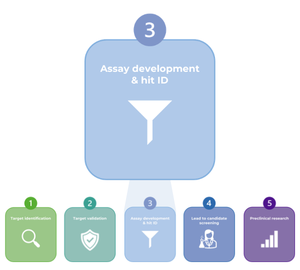
Assays underpin many of the critical decisions made during drug discovery. From identifying active compounds and validating targets to understanding mechanisms of action and optimising leads, a well-designed assay provides the reliable biological data needed to decide which candidates are worth pursuing.
Developing an effective assay, however, involves more than selecting a detection method. The assay must answer the right biological question while delivering sufficient sensitivity, reproducibility and robustness for its intended application.
What is assay development?
Assay development is the process of designing and establishing an experimental method to measure a specific biological activity or physical characteristic associated with a potential drug or therapeutic target. Depending on the research question, an assay might measure whether a compound binds to a target, inhibits an enzyme, alters a signalling pathway or produces a particular response in living cells. Assays can also determine quality and potency characteristics of the drug and track the stability and biological fate within various biological matrices.
Throughout drug discovery, assays can support target validation, hit identification, lead optimisation, mechanism-of-action studies, biomarker research and safety evaluation.
The most appropriate assay therefore depends heavily on the stage and objectives of the programme. A biochemical assay designed to investigate direct target activity has very different requirements from a cell-based assay intended to assess downstream biological effects (1-3).
Choosing the right assay format
A clear biological question should come before assay selection. Researchers need to establish the target or pathway of interest, the response they want to measure and how the resulting data will be used.
Common assay formats include:
- Biochemical assays: measure the activity of an isolated target, such as enzyme inhibition.
- Binding assays: used to investigate interactions and affinity between molecules and targets.
- Biophysical assays: characterise compound characteristics, providing information on purity, stability and aggregation
- Cell-based assays: assess responses within a more biologically complex cellular environment.
- Reporter & functional assays: measure changes in signalling, gene activity or specific biological outcomes.
- Phenotypic assays: examine broader changes in cells or other biological models without necessarily beginning with a predefined molecular target.
Using complementary or orthogonal assays can also strengthen confidence in results. For example, biochemical evidence that a compound inhibits its intended target can be followed by a cell-based assay to determine whether that activity translates into the expected cellular response (3, 4).
From initial assay to an optimised workflow
Once an assay format has been selected, experimental conditions must be established and refined. Variables such as reagent and sample concentrations, incubation times, detection methods and controls can all influence performance.
Optimisation aims to increase the distinction between genuine biological activity and background noise while maintaining sensitivity and an appropriate dynamic range. Reproducibility is particularly important: an assay should continue to produce consistent results across different experiments, operators, instruments and testing days.
Appropriate positive and negative controls are equally important. Without them, distinguishing a biological effect from experimental variation becomes considerably more difficult.
Development and optimisation are closely related, but they have different purposes. Development establishes a working experimental system, while optimisation turns that system into a reliable assay suitable for routine use or screening.
Validating assay performance
Before an assay is used to support major drug discovery decisions, researchers need confidence that its results can be trusted. Validation may consider characteristics including accuracy, precision, specificity, repeatability, reproducibility and stability (3, 5).
This step is particularly important when an assay will be transferred into higher-throughput applications. High-throughput screening can involve testing thousands or potentially millions of compounds, meaning small sources of variability can become significant when scaled across a large screening campaign.
Scalability should therefore be considered during development rather than as an afterthought. An assay that works well manually in a small experiment may require further optimisation before it can be transferred successfully to automated platforms.
Avoiding common assay development pitfalls
Many assay development problems originate from decisions made early in the process. Choosing a technically sophisticated assay that does not adequately address the biological question can generate results that are difficult to interpret. Similarly, inadequate validation increases the likelihood of false positives or false negatives, potentially directing time and resources towards inappropriate candidates.
Biological context matters too. Activity observed against an isolated protein does not necessarily predict how a compound will behave within a living cell. Combining complementary assay formats can therefore provide a more complete picture of compound activity (1, 2, 4).
Ultimately, successful assay development means starting with the intended application in mind. Designing for biological relevance, robust controls, reproducibility and eventual scale creates a stronger experimental foundation for screening and subsequent drug discovery decisions.
Supporting successful drug discovery
Reliable assays help researchers distinguish promising drug candidates from experimental noise and make better-informed choices about which molecules to progress. Selecting appropriate reagents, biological models and detection technologies at the outset can make assay development and optimisation more efficient while improving confidence in the resulting data.
Cambridge Bioscience provides a wide range of reagents, assays and research tools to support drug discovery workflows, from early target investigation through compound screening and downstream validation.
This blog forms part of our drug discovery workflow series. Read more related content - Cambridge Bioscience: Life science blog
References
1. Wu Y, Jensen N, Rossner MJ, Wehr MC. (2024). “Exploiting Cell-Based Assays to Accelerate Drug Development for G Protein-Coupled Receptors.” International Journal of Molecular Sciences, 25(10), 5474.
2. Swinney DC. (2014). “The value of translational biomarkers to phenotypic assays.” Frontiers in Pharmacology, 5, 171.
3. Marugán C, Torres R, Lallena MJ. (2016). “Phenotypic Screening Approaches to Develop Aurora Kinase Inhibitors: Drug Discovery Perspectives.” Frontiers in Oncology, 5, 299.
4. Heynen-Genel S, Pache L, Chanda SK, Rosen J. (2012). “Functional genomic and high-content screening for target discovery and deconvolution.” Expert Opinion on Drug Discovery, 7(10), 955–968.
5. Zhang XD, Wang D, Sun S, Zhang H. (2020). “Issues of Z-factor and an approach to avoid them for quality control in high-throughput screening studies.” Bioinformatics, 36(22–23), 5299–5303.