
- In this section:
- Request a TransIT-LT1 sample
- TransIT-LT1 citations
TransIT®-LT1 from Mirus BIo is a broad spectrum, low toxicity, serum-compatible DNA transfection reagent. Providing an efficient and cost-effective transfection option, TransIT-LT1 is ideal for use with a wide range of cell types including primary cells.
Benefits of using TransIT-LT1
• Broad spectrum DNA delivery
• Exceptionally low cellular toxicity
• Transfects adherent and suspension cells
• High efficiency delivery
• Delivers single or multiple plasmids
• Stable and transient transfection
• Serum compatible
Customer testimonial
"Our lab regularly transfects head and neck cancer squamous carcinoma cell lines as well as pre-cancerous oral lesion cell lines and primary cells with Mirus Bio products. We recently published a paper using Mirus Bio TransIT-LT1 in which we concluded tobacco carcinogens up-regulate AP-1 activity and AP-1 dependent IL-8 and VEGF gene expression in head and neck cancer."
Swenson, W et al. Molecular Carcinogenesis, April 2011. Beverly Wuertz, University of Minnesota, F. Ondrey Lab
Exceptional transfection efficiency in human induced pluripotent stem cells (iPSCs) via reverse transfection with TransIT-LT1
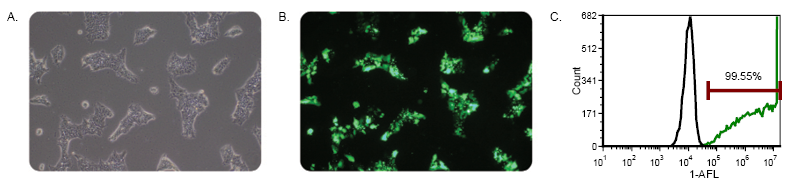
The TransIT-LT1 was used to reverse transfect 1.3 x 10⁶ iPS cells with a ZsGreen expressing plasmid (Clontech). Reverse transfections were performed in 6-well plates using 12 µl of TransIT-LT1 to deliver 4 µg of DNA (3:1, reagent: DNA). Cells were visualised 48 hours post-transfection and imaged under a 10X objective with an Olympus IX71® Inverted Microscope. Images are (A) phase contrast and (B) green fluorescence. Cells were assayed 48 hours post-transfection on an Accuri® Cytometer. The histogram (C) shows untransfected cells (black line) compared to cells transfected with plasmid using TransIT-LT1 (green line).
TransIT-LT1 reagent exhibits higher expression and lower cellular toxicity compared to other transfection reagents
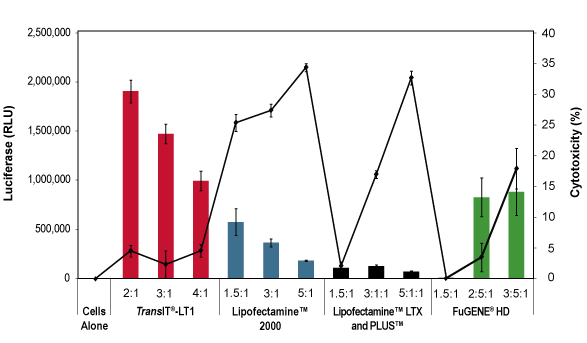
HepG2 cells were transfected with a luciferase expression plasmid. Transfections were performed in 96-well plates using 0.1 µg of plasmid DNA/well. Luciferase expression (bar graph) and lactate dehydrogenase (LDH) levels (line graph) were measured at 24h post-transfection. LDH levels are reported as % cytotoxicity compared to cells alone and measured using a commercially available colorimetric assay; all values at or below zero are represented as zero on graph.
Comparable luciferase expression with the TransIT-LT1 reagent and FuGENE® 6 in multiple cell types
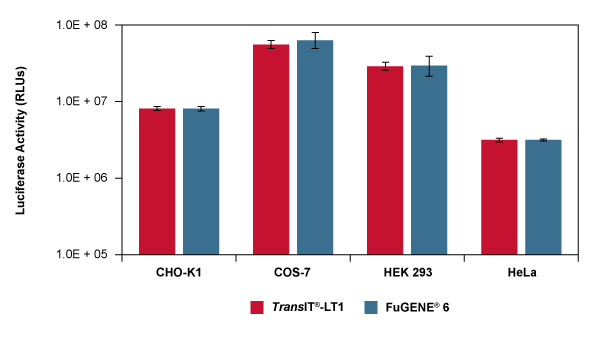
The indicated cell lines were transfected in duplicate with 1 µg of a luciferase expression vector per well of a 12-well plate using either 3 µl of the TransIT-LT1 or FuGENE® 6 Reagents according to industry accepted testing protocols. Cells were harvested 24 hours post-transfection and assayed for luciferase activity.
Applications
• Virus production
• Stem cell transfection
• Stable transfection
Free samples
Request a free sample of TransIT-LT1
Material available for download
TransIT-LT1 manual
Reverse transfection of human induced pluripotent stem (iPS) cells protocol
FuGENE is a registered trademark of Fugent LLC. Accuri is a registered trademark of Becton, Dickinson and Company. Olympus IX71 is a registered trademark of Olympus Life Science. Lipofectamine is a trademark of Thermo Fisher Scientific. PLUS is a trademark of Invitrogen.
Products
Note: product availability depends on country - see product detail page.
| Details | Cat number & supplier | Size | Price |
| TransIT-LT1 Transfection Reagent MIR 2304 · Mirus | MIR 2304 Mirus |
0.4 ml |
£321.00
0.4 ml
view
|
| TransIT-LT1 Transfection Reagent MIR 2300 · Mirus popular product | MIR 2300 Mirus |
1 ml |
£507.00
1 ml
view
|
| TransIT-LT1 Transfection Reagent MIR 2305 · Mirus | MIR 2305 Mirus |
5 x 1 ml |
£2195.00
5 x 1 ml
view
|
| TransIT-LT1 Transfection Reagent MIR 2306 · Mirus | MIR 2306 Mirus |
10 x 1 ml |
£4055.00
10 x 1 ml
view
|
